
7 Signs Your Home Needs an Electrical Panel Upgrade
Your electrical panel is the heart of your home's power. It decides how much electricity your house can safely use, and where every circuit begins and ends. It quietly does its job for years, which is exactly why most homeowners never give it a second thought. That is, right up until the lights flicker, a breaker keeps tripping, or they go to add an EV charger and find out the panel cannot handle it.
If your home is in Riverside, Jurupa Valley, Hemet, or anywhere across the Inland Empire, and it was built more than a couple of decades ago, there is a good chance your panel is working harder than it was ever designed to. Homes today run far more than the homes these panels were built for. Central air, electric ranges, dishwashers, multiple TVs, a dozen devices charging at once, and now electric vehicles. The demand has climbed. In a lot of older homes, the panel has not.
Here are seven signs it may be time for an upgrade, and what each one is really telling you.
1. Your breakers trip again and again
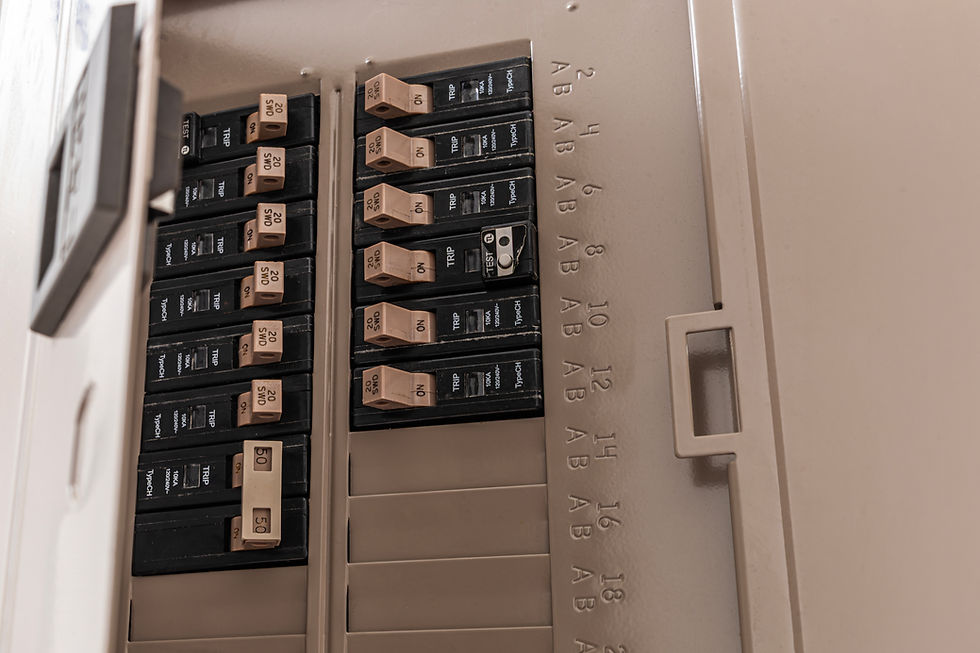
Circuit breakers protect individual circuits. Repeated trips should be assessed by a licensed electrician.
A breaker that trips once in a while is doing its job. It is cutting power to protect you from an overloaded circuit, and that is a good thing. The trouble starts when it becomes routine. If the kitchen goes dark every time you run the microwave and the toaster together, or a breaker will not stay on no matter what you do, the circuit is carrying more than it was built for.
Resetting it over and over is treating the symptom, not the cause. The real fix is usually more capacity, which means a panel that can actually support how you live.
2. The panel feels warm, or you hear buzzing
A healthy panel is quiet, and the cover stays cool to the touch. If you feel warmth coming off it, catch a faint smell of burning plastic, or hear a buzzing, humming, or crackling sound, treat it as urgent and call a licensed electrician right away. Those are classic signs of loose connections, corrosion, or an overloaded system, and they are the kind of problem that gets worse quietly behind the wall.
3. Your lights flicker or dim
A single flicker during a storm is nothing to worry about. A pattern is different. If the lights dip every time the air conditioner cycles on, or dim when the dryer starts, your panel is struggling to keep up with the demand being placed on it. It is a sign the service has been outgrown, and often an early warning before bigger problems show up.
4. You still have a fuse box, or power strips in every room
Illustration: older plug fuses and modern circuit breakers look different. Have an electrician assess the system's condition and capacity.
Fuse boxes were built for a different era, back when a home ran a refrigerator, a few lights, and a radio. They are not automatically dangerous, but they were never designed for the electrical load of a modern household. If yours still has one, it is worth a professional look.
The same goes for power strips and extension cords. If you rely on them in every room just to have enough outlets, that is not a convenience issue, it is a capacity issue. Your home is quietly telling you it needs more.
Not sure what you are looking at? You do not have to diagnose this yourself. Send us a photo of your panel label, or book a free assessment, and we will tell you straight where your home stands. Call (951) 842-0356.
5. You are adding something big

An EV charger adds a substantial electrical load. Check your home's available capacity before installation.
Planning an EV charger, a new central air unit, a hot tub, a workshop, or a room addition? These are large loads, and they are the single most common reason Inland Empire homeowners discover their panel is already maxed out.
A Level 2 EV charger alone can pull as much power as a small home. If your service has no headroom left, there is simply nowhere to add it safely. Upgrading before the new install is almost always cleaner and cheaper than patching around a full panel afterward.
6. Your panel is a known problem brand
Name guide, not a manufacturer-label photograph. Ask a licensed electrician to confirm the brand and model on your accessible panel label.
Some older panels are known in the trade to fail at the one job they exist to do, which is trip when a circuit is overloaded. Federal Pacific and Zinsco are the two names that come up most often. They can look completely normal and still not trip when they should, and that is exactly what makes them a risk. Many insurers now flag these panels during inspections.
If your home was built before the 1990s, take two minutes to check the brand on your panel label.
7. Your panel is old or under 100 amps
Illustration: amp markings indicate capacity. The correct service size depends on a professional load calculation.
If your electrical service is 25 years or older, or rated under 100 amps, it was built for a smaller electrical life than most families live today. You feel it in the tripped breakers and the dimming lights, but the real issue is that the whole system is running closer to its limit than it should.
Upgrading to a 200 amp service is the common fix. It gives your home the capacity to run everything safely, with real room to grow.
What a panel upgrade actually involves
It is a lot more than swapping a box on the wall. We start with a load calculation to size the new service to your home. From there we coordinate the shutdown with the utility, remove the old panel, set the new one in place, land and label every circuit, and bond and ground it to current code. Then it goes through inspection, because work of this size should be checked by an independent set of eyes before it is closed up.
Done right, a panel upgrade is something you never have to think about again. That is the whole point of doing it properly.
Quick answers to common questions
Do I really need a permit? Yes, and you want one. A permit means the work is inspected and on record, which protects you when you sell, insure, or build on it later.
Can I just add a breaker instead? Sometimes, but not if the panel is already full or the service is undersized. That is what the load calculation tells us.
Not sure where your panel stands?
If any of these signs sound like your home, the smart first step is simple. Get it looked at. We will inspect your panel, explain what we find in plain language, and tell you honestly whether it needs attention. No pressure either way.
Franco Bros. Electric is a family owned, licensed and insured electrical contractor serving Riverside and the wider Inland Empire. Call us at (951) 842-0356 for a free panel assessment.


Comments